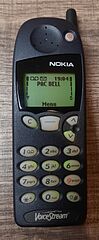
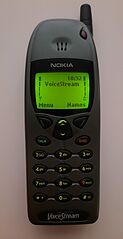
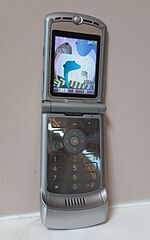
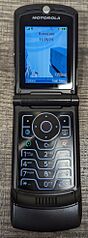
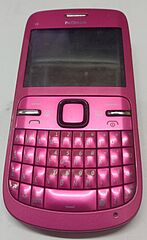
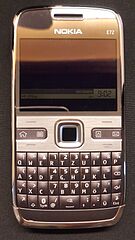
There exists a small but non-trivial community of people (estimate around 20 thousand in USA) who wish to keep using old mobile phones: old Nokias, Motorolas and so forth. These old phones require cellular networks that are different from what the major nationwide carriers operate: while the 3 big carriers operate only 4G and 5G networks, retro mobile phones from 1990s and 2000s require cellular networks based on GSM technology, also known as 2G.
American 2G Cooperative (A2GC) is a non-profit membership co-op that seeks to build a new GSM/2G network specifically for those human users who intentionally wish to use a vintage mobile phone (1990s through early 2010s) as their personal communication device. We are seeking to build this network on a realistic small scale, only in a few carefully chosen geographic locations, as detailed below.
Out of the two frequency bands that exist in USA (FCC jurisdiction) and are suitable for provision of GSM service (compatible with the millions of already made historical phones), GSM850 has more vacancies than PCS1900: there are more places across the country with a vacancy in 850 MHz spectrum allocation than a similar vacancy in 1900 MHz band. All locations with such vacancies are very rural and remote, but they do exist, and FCC rules allow any company to apply for a new license in any of these so-called Unserved Areas.
For our very first GSM850 network deployment, we are currently considering candidate locations in Central and Eastern Oregon, as well as some remote desert parts of California and Arizona. Whichever location we finally settle on, our initial system will consist of a single cell site and will have a coverage area anywhere between 50 and 1400 square miles. 50 sq miles is the minimum coverage area required by FCC; 1400 sq miles is the theoretical maximum coverage area from a single cell site if it is ideally located with respect to terrain. Our coverage area will depend on how good of a location we can get.
Our current estimate is that we will finalize our choice of location some time in 2027 and launch service some time in 2028.
Every old phone that supports GSM850 frequency band also supports PCS1900, but not the other way around: there exist many interesting old phones that support 1900 MHz frequency band for GSM, but not 850 MHz. Therefore, our Cooperative needs to make every effort to get access to at least one location where we can operate GSM service in PCS1900 band.
This map shows all locations across USA where a vacancy exists in Broadband PCS 1900 MHz spectrum allocation, i.e., every area where a portion of this spectrum is currently vacant, not assigned to any company. This situation exists in places where some previously issued licenses were canceled or terminated, or expired without renewal. Out of these locations, we are mostly interested in the cluster of vacancies in the state of Oregon — but we may also pursue other locations depending on who else joins the Cooperative and where their interests lie.
No matter which specific location(s) we are interested in on that map, getting access to any of the vacancies in PCS1900 band (as opposed to GSM850) will be an arduous political venture. For this reason, our plan is to prove ourselves as a high-quality GSM850 operator first, and only then pursue PCS1900 spectrum. If we launch our first GSM850 service some time in 2028, perhaps we will be in a good position in pursue PCS1900 in another year or two afterward.
A2GC is a non-profit organization, incorporated in Delaware. We are recognized by IRS as a tax-exempt entity under Internal Revenue Code section 501(c)(12), the category of mutual or cooperative telephone companies. Please note it is a different type of tax-exempt non-profit entity from the usual 501(c)(3) — see IRS publication 557. Like all tax-exempt non-profit entities, we are required to publicly disclose our management structure, bylaws, financial details and so forth. All of this information can be found in our documents directory. Our federal EIN is 33-4896531.
Anyone with an interest in our work is cordially invited to email any of our corporate officers: